Visualizing the Future of Learning: How 49 Online Education Glyph Icons Enhance Digital Engagement
The landscape of education and professional development has undergone a fundamental transformation. We have moved beyond the physical constraints of the traditional classroom into an era where knowledge is ubiquitous, accessible, and increasingly digital. For creators, entrepreneurs, and educational technology professionals, the challenge is no longer just about delivering content; it is about presenting that content in a way that is intuitive, engaging, and visually coherent across a multitude of devices. In this context, visual language has become the currency of user experience. It is here that the utility of a comprehensive design asset, specifically a set of 49 Online Education Glyph Icons, becomes a critical component of modern digital strategy.
The Necessity of Visual Semantics in E-Learning
As the e-learning market expands, user expectations have matureured. Learners today are sophisticated consumers of digital interfaces, conditioned by the seamless experiences offered by leading social media and entertainment platforms. They expect immediate visual cues to navigate complex systems. Whether it is a freelancer taking a crash course on marketing automation, a student pursuing a global degree, or an employee undergoing compliance training, the cognitive load must be minimized.
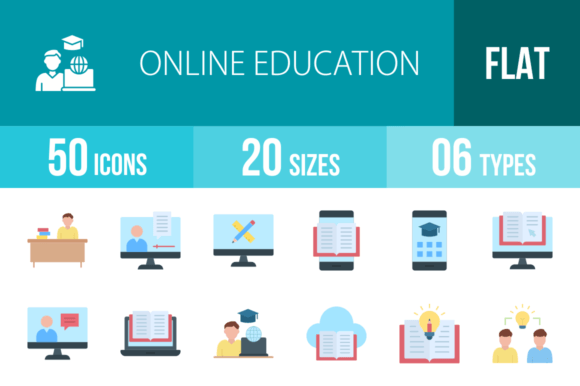
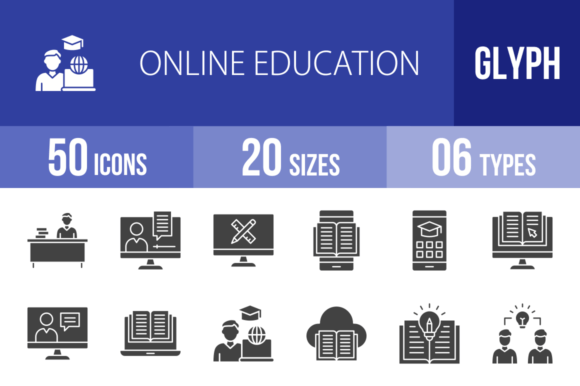
This is where the specific utility of the 49 Online Education Glyph Icons comes into play. These are not merely decorative elements; they are functional tools designed to bridge the gap between the user and the interface. By utilizing a standardized set of glyphs—ranging from the Student Desk to Virtual Education—developers and designers can create a universal language that transcends text. In a mobile-first world, where screen real estate is at a premium, a well-designed icon representing an Online Course or an Education App communicates value faster than a paragraph of text ever could.
Addressing the Fragmentation of the Modern Learning Environment
The modern educational ecosystem is fragmented. Learning happens on laptops during commutes, on tablets in coffee shops, and on desktops in offices. This fragmentation presents a significant design challenge: how to maintain brand consistency and usability across different operating systems and screen resolutions. The 49 Online Education Glyph Icons are engineered to solve this specific problem. Designed using a unigrid system, these icons ensure that whether they are viewed on a high-resolution Retina display or a standard mobile screen, the visual integrity remains intact.
Consider the workflow of a course creator or an EdTech startup. They are building platforms that host Video Conferencing, Recorded Lectures, and Online Libraries. If the icon for "Play" looks different from the icon for "Download EBook," the user experience becomes disjointed. By utilizing a cohesive set of vector assets, professionals can ensure that the transition from Microlearning modules to Group Class sessions feels seamless. The availability of multiple formats—AI, CDR, EPS, JPG, PNG, and SVG—ensures that these assets can be integrated into any workflow, whether the designer is using Adobe Illustrator for high-fidelity mockups or a web-based builder for rapid prototyping.
Practical Applications: Beyond Aesthetics
The true value of these assets lies in their application. For the entrepreneur launching a new learning management system (LMS), the icon set serves as a foundational design system. Instead of commissioning custom graphics for every feature, they can leverage the pre-designed 49 Online Education Glyph Icons to map out their user journey.
- Onboarding and Navigation: Using distinct glyphs for Online Counselling or Language Translation helps users locate support features instantly.
- Marketing and Presentation: For marketers pitching a new educational product, these icons serve as professional visual aids. A slide deck featuring Global Education or Sharing Ideas icons elevates the perceived value of the proposition.
- Certificate and Credentialing: In the age of digital credentials, the inclusion of icons representing Certificate, Diploma, and Graduation allows institutions to design visually appealing digital badges and PDF certificates that are lightweight and scalable.
Furthermore, the set addresses specific niche needs within the educational sphere. For instance, the rise of Games Based Learning and Practice Based Learning requires visual indicators that differ from traditional lecture-based formats. Having a dedicated icon for Online Test or Problem Solving allows platform builders to categorize content types effectively, aiding in the filtering and discovery process for learners.
Aligning with Mobile and Responsive Trends
The requirement for assets to be "suitable for mobile apps" is not just a feature; it is a mandate. With the majority of internet traffic coming from mobile devices, educational platforms must be responsive. The 49 Online Education Glyph Icons are optimized for this reality. The vector nature of the SVG and EPS formats means they can be scaled infinitely without pixelation, ensuring that an icon representing Mobile Learning looks crisp on a smartwatch or a 4K monitor.
This scalability is essential for the growing market of educational wearables and IoT devices. As the interface of learning expands, the need for clear, scalable visual communication grows. The unigrid system ensures that the visual weight of the Online Class icon is balanced with that of the Online Document icon, creating a harmonious user interface that reduces eye strain and improves navigation speed.
The Business Case for Standardized Visual Assets
For freelancers and agencies, time is money. The development of custom iconography for every client project is often cost-prohibitive. By adopting a comprehensive set like the 49 Online Education Glyph Icons, professionals can accelerate their design and development cycles. This efficiency allows for a greater focus on user experience strategy and content quality—the true differentiators in the crowded e-learning market.
Moreover, the inclusion of icons like Stationary and Laptop alongside more abstract concepts like Idea and Online Knowledge provides a holistic toolkit. It acknowledges that education is a blend of the physical and the digital. It recognizes that while the medium has changed, the fundamental elements of learning—tools, institutions, and human interaction—remain constant.
Conclusion: A Tool for the Modern Educator and Creator
The shift towards digital education is irreversible. As we continue to build the platforms and content that will educate the next generation of professionals, the tools we use to communicate must be as sophisticated as the content itself. The 49 Online Education Glyph Icons represent more than just a collection of vector files; they represent a design philosophy centered on clarity, scalability, and user-centricity.
For the professional, the creator, or the entrepreneur, investing in high-quality, versatile design assets is a strategic move. It ensures that the message is not lost in translation, regardless of the device or platform. By integrating these icons into their digital products, creators can ensure that their educational offerings are not only informative but also visually compelling and intuitively navigable. In the attention economy, where clarity is king, these icons are an essential asset for anyone serious about the future of online learning.