Visualizing Civic Engagement: A Practical Review of 50 Democracy Glyph Icons
In the current digital landscape, the ability to communicate complex ideas quickly is paramount. Visual assets are no longer just decorative; they are functional tools for navigation, storytelling, and branding. For creators working within the civic, political, or educational sectors, finding high-quality, thematic graphics can be a persistent challenge. This is where a focused asset like the 50 Democracy Glyph Icons set becomes a relevant subject of discussion. It presents itself not as a generic clipart collection, but as a specialized toolkit designed for clarity and consistency across multiple platforms.
Structural Integrity and Format Versatility
One of the most critical aspects of any digital asset pack is its adaptability. A professional workflow demands files that integrate seamlessly into existing software environments. The 50 Democracy Glyph Icons collection addresses this by offering six distinct formats: AI, CDR, EPS, JPG, PNG, and SVG. This range is significant. The inclusion of vector formats (AI, EPS, SVG) ensures that the icons can be scaled to any size without loss of quality—essential for everything from a small mobile app button to a large-format event banner or printed presentation slide. Meanwhile, the provision of JPG and PNG formats caters to users who require ready-to-use raster images for web content or social media posts.
Furthermore, the set includes 20 different PNG sizes for the 50 icons. This specificity is a practical strength. It eliminates the need for manual resizing for common web and app dimensions, streamlining the workflow for developers and web designers. The foundation of these designs on a grid system also suggests a level of precision that translates to better alignment and visual harmony when the icons are used in groups or within interface elements.
Thematic Range and Semantic Clarity
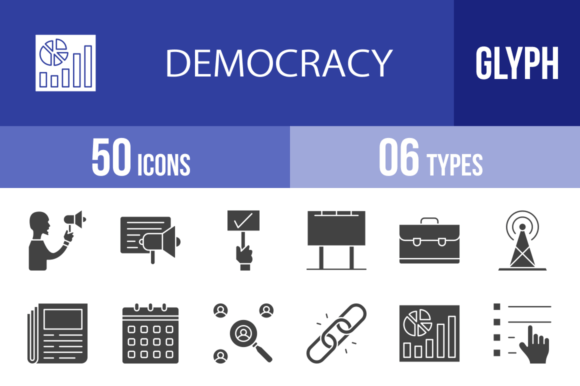
The utility of an icon set is heavily dependent on its vocabulary. A list of 50 icons might sound arbitrary, but the selection within this 50 Democracy Glyph Icons pack demonstrates a thoughtful approach to the theme of civic engagement and governance. The collection moves beyond the obvious symbols of a ballot box or a flag. It includes nuanced concepts such as Freedom Of Speech, No Corruption, Equality, and Oath.
This breadth allows for sophisticated visual storytelling. For example, a non-profit organization creating a report on global voting rights could use the Online Voting, Ballot, and Smartphone icons to illustrate modern challenges. Similarly, an educational platform could use Constitution, Law, Legislative, and Supreme Court to build a visual glossary for students. The inclusion of role-specific icons like Candidate, President, Prime Minister, and Activist further enhances its utility for news media, political blogs, and campaign materials. Each glyph is designed to be immediately recognizable, reducing cognitive load for the viewer and improving the overall user experience.
Practical Applications Across Professions
The real-world value of the 50 Democracy Glyph Icons lies in its cross-disciplinary applicability. Here is a breakdown of who stands to benefit and how:
- Web and App Developers: The SVG and AI formats are ideal for integrating into user interfaces for civic tech applications, government portals, or polling platforms. The consistency of the grid system ensures that the icons will look cohesive when placed side-by-side in a navigation bar or a feature list.
- Content Marketers and Bloggers: For writers covering politics, social justice, or business, these icons serve as effective visual breaks and thematic anchors within articles. Using the Newspaper, Broadcast, or Blog (implied in web contexts) icons can visually categorize content, making it more scannable for readers.
- Educators and Presenters: The PNG and JPG formats are perfect for insertion into slide decks. Teachers can use the Chart, Statistics, or Vote icons to make data more engaging, while the Human Rights and Equality icons can underscore key ethical points in a lecture.
- Graphic Designers: When tasked with creating posters for an election, materials for a town hall, or branding for a think tank, this set provides a ready-made visual language. The ability to edit and scale the vectors means they can be customized to match specific color palettes or stylistic requirements.
Evaluating Quality and Consistency
A common pitfall in many icon packs is inconsistency—varied line weights, differing levels of detail, or misaligned visual metaphors. The 50 Democracy Glyph Icons appear to mitigate this through the use of a unified design system. Each icon, from Megaphone to Parliament, shares a similar aesthetic weight and visual balance. This is not merely an aesthetic concern; it is a functional one. Inconsistent icons can make a professional product look amateurish and can confuse users.
The claim of being designed for "maximum usability" is supported by the range of symbols. The inclusion of both abstract concepts (Agree, Disagree, Judgment) and concrete objects (Briefcase, Microphone, Calendar) gives the designer flexibility to represent ideas that are not easily photographed or illustrated. The set also includes action-oriented symbols like Protest and Debate, which are particularly useful for dynamic content like event promotions or social media campaigns.
Considerations and Limitations
No resource is without its constraints. While the 50 Democracy Glyph Icons set is robust, potential users should consider a few points. Firstly, the aesthetic is glyph-based, meaning they are likely single-color, minimalist designs. While this is excellent for clean, modern layouts, it may not suit projects requiring highly detailed, illustrative, or photorealistic imagery. Secondly, while 50 icons cover a significant range, a highly specialized project might find gaps. For instance, an icon for "gerrymandering" or "referendum" is not listed, though related concepts like Chart or Vote could be used metaphorically.
It is also important to verify the licensing terms for commercial use, especially for large-scale distribution or product integration. The description mentions it is "ready to use," but professional due diligence always involves checking the end-user license agreement. Finally, the effectiveness of any icon depends on context. The Chain icon, for example, could represent a link or unity, but in a negative context, it might imply bondage. Clear accompanying text or UI design is necessary to guide interpretation.
Final Verdict: A Targeted and Functional Asset
In summary, the 50 Democracy Glyph Icons set presents a compelling case as a practical, well-structured resource for anyone working with themes of governance, civic participation, and social discourse. Its strength lies not in novelty, but in its deliberate design for real-world application. The combination of multiple file formats, a thoughtful selection of symbols, and a consistent grid-based design system makes it a reliable tool for professionals who need to communicate complex ideas with visual efficiency.
For the web developer building a voter registration portal, the blogger analyzing election data, or the educator crafting a curriculum on civil rights, this collection offers a significant head start. It reduces the time spent searching for or commissioning thematic graphics and increases the potential for creating cohesive, professional, and engaging visual content. While it is a specialized set, its utility within its niche is clear, making it a worthy consideration for relevant projects.