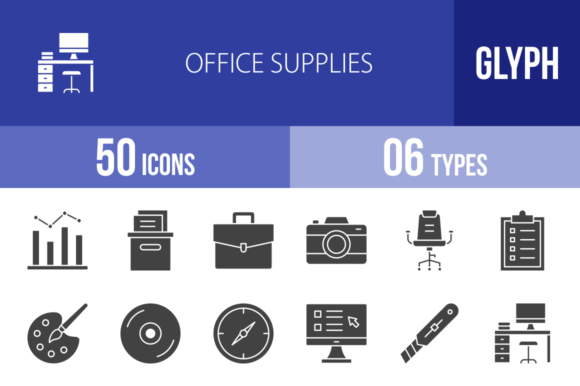
Elevating Digital Communication: The Strategic Impact of a 50 Office Supplies Glyph Icons Collection
In the contemporary digital landscape, the line between functional utility and aesthetic appeal has blurred. For professionals, creators, and entrepreneurs, the tools used to communicate ideas are just as important as the ideas themselves. This shift has given rise to a demand for high-quality, versatile design assets that streamline workflows while maintaining a polished, professional appearance. Among these assets, the 50 Office Supplies Glyph Icons collection stands out as a quintessential resource, bridging the gap between the tangible world of stationery and the abstract realm of digital interfaces.
Understanding the Glyph Icon Ecosystem
At its core, a glyph icon is more than a simple illustration; it is a standardized visual language. The 50 Office Supplies Glyph Icons set is designed using a unigrid system, a methodology that ensures consistency in weight, height, and visual balance across every symbol. This consistency is critical for user interface (UI) and user experience (UX) design. When a user views a Pen, a Pencil, or a Clipboard within an application, the subconscious recognition of these shapes allows for intuitive navigation.
This collection specifically addresses the hybrid nature of modern work. It encompasses traditional analog tools—such as the Paperclip, Stapler Remover, and Eraser—alongside digital necessities like the Flash Disk, Hard Drive, and Server. By combining these into a single cohesive set, designers can create interfaces that reflect the reality of the modern workspace, where a Notebook might sit next to a Laptop, and a Printer connects wirelessly to a Computer.
The Versatility of 6 Different Formats
One of the defining characteristics of a professional-grade asset library is its adaptability. The 50 Office Supplies Glyph Icons are provided in 6 different formats: AI, CDR, EPS, JPG, PNG, and SVG. This technical versatility is not merely a convenience; it is a necessity in a fragmented technological environment.
- SVG (Scalable Vector Graphics): Essential for web development. These icons remain crisp and clear regardless of the screen resolution, whether viewed on a 4K monitor or a mobile device.
- AI and EPS: These vector formats are the industry standard for print design and large-scale illustration, allowing creators to scale the Whiteboard or Desk icons to billboard size without pixelation.
- PNG: With 20 PNG sizes available for the 50 icons, developers can optimize load times for mobile apps by selecting the exact resolution required, ensuring that the Inbox or Envelope loads instantly on a smartphone.
This multi-format approach aligns with the broader trend of design system integration. Companies are moving away from ad-hoc design choices toward centralized systems where assets must function seamlessly across print collateral, website headers, and mobile application menus.
Meeting the Demands of Modern Workflows
The relevance of these icons extends beyond aesthetics; it is deeply rooted in changing workflows. The rise of remote work and the "digital nomad" lifestyle has necessitated tools that are lightweight yet powerful. Entrepreneurs and freelancers often rely on all-in-one solutions.
Consider the Briefcase icon. In a traditional context, it represents physical luggage. In a modern app context, it symbolizes project management, business analytics, or client portfolios. Similarly, the Color Palette is not just for artists; it is a standard symbol for customization settings in software ranging from CRM platforms to social media schedulers.
The collection also acknowledges the physical reality of the office. The inclusion of the Water Bottle, Chair, and Desk Lamp reflects a holistic view of the workspace. For HR software, wellness apps, or interior design portfolios, these specific glyphs provide the nuance required to tell a complete story about the work environment.
Practical Applications for Professionals
For the target audience—marketers, freelancers, and business owners—the practical applications of the 50 Office Supplies Glyph Icons are vast. The ability to edit and scale these vectors easily means that a marketing team can rebrand an entire suite of digital products in hours rather than days.
- Website Navigation: Using a Folders icon for the "Archive" section or a Trash icon for the "Delete" function relies on established mental models. These icons reduce cognitive load, allowing users to process information faster.
- Mobile App Interfaces: In mobile design, screen real estate is premium. A single, well-designed Light Bulb or Tools icon can replace lengthy text labels, creating a cleaner, more intuitive user experience.
- Infographics and Presentations: When presenting data to stakeholders, a Bar Chart icon or a Stamp can break up text-heavy slides, making complex information more digestible and engaging.
The Intersection of Technology and Tradition
There is a fascinating psychological component to the use of office supply icons. As the world becomes increasingly digitized, there is a counter-movement of nostalgia and comfort found in analog items. The Postcard, Sticky Note, and Tape icons evoke a sense of tactile interaction that screens often lack.
Designers leverage this by using these glyphs to humanize technology. A digital "note-taking" app feels more approachable when it uses a Notebook icon rather than an abstract geometric shape. The 50 Office Supplies Glyph Icons collection capitalizes on this by offering 100 vector icons (implying variations or a robust set of the 50 distinct concepts) that bridge the gap between the warmth of the physical office and the efficiency of the digital one.
Furthermore, the inclusion of tech-adjacent items like the Internet, Headphones, and Camera acknowledges that the "office" is no longer a static room. It is wherever the professional happens to be. These icons support the narrative of a connected, mobile workforce.
Design Consistency and the Unigrid System
A recurring challenge in design is maintaining visual harmony. When icons are sourced from different libraries, the mismatch in line weight or style can make a product look amateurish. The 50 Office Supplies Glyph Icons are designed using a unigrid system. This ensures that the Computer icon has the same visual gravity as the Paper Shredder.
This consistency is vital for branding. A cohesive visual identity builds trust. When a user interacts with an interface where the Id Card, Key (metaphorically present in security features), and Keyboard all share the same design DNA, the experience feels professional and intentional. It signals to the user that the developers care about the details, which often translates to a perception of higher quality in the core product.
Future-Proofing Your Design Assets
Investing in high-quality, versatile assets like the 50 Office Supplies Glyph Icons is a form of future-proofing. As new platforms emerge—whether they are AR/VR interfaces or new mobile operating systems—the need for scalable, editable vectors remains constant.
The fact that these icons are ready to use for all devices and platforms means they are not tied to a specific software version or operating system. Whether a designer is creating a prototype for a smartwatch or a layout for a desktop dashboard, the Compass, Glue Stick, or Push Pin can be adapted to fit the context.
Moreover, the semantic richness of the set—covering everything from Staples to Servers—ensures that it remains relevant as business needs evolve. A startup might initially use the Box and Tools icons for a logistics app, but later repurpose the Color Palette and Illustration assets for a creative marketing campaign.
Conclusion: The Utility of Precision
The 50 Office Supplies Glyph Icons collection represents more than just a set of pictures. It is a toolkit for modern communication. By offering a blend of analog nostalgia and digital precision, in formats that support every conceivable use case, it empowers professionals to build better, faster, and more beautiful products.
In a market where user attention is scarce, the clarity provided by well-designed glyphs—such as the Flash Disk for storage or the Light Bulb for ideas—is invaluable. For the creator looking to streamline their workflow or the entrepreneur aiming to polish their brand image, these icons provide the visual vocabulary needed to succeed in a visually driven world.