50 Natural Disaster Flat Multicolor Icon: A Practical Evaluation for Digital Projects
Selecting the right visual assets is a critical step in the design process, especially when dealing with complex or sensitive topics like environmental hazards. The 50 Natural Disaster Flat Multicolor Icon set offers a specific approach to this challenge, providing a collection of vector graphics designed for clarity and immediate recognition. This evaluation explores its features, ideal applications, and how it stands relative to other visual communication strategies.
Understanding the Core Offering
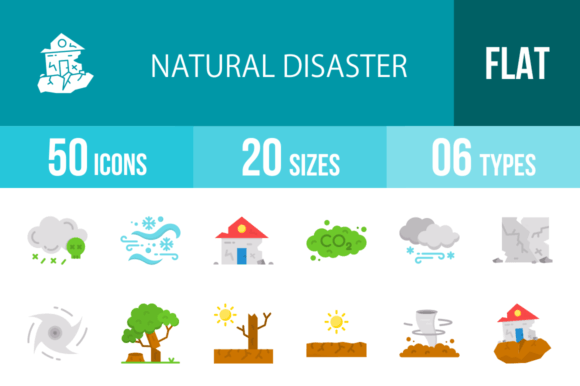
At its foundation, this collection is a 50 Natural Disaster Flat Multicolor Icon pack. The "flat multicolor" style is its most defining characteristic. Unlike monochromatic line icons or photorealistic illustrations, each icon uses a limited palette of solid, vibrant colors to depict its subject. This design philosophy prioritizes quick comprehension and visual consistency across a series. The icons cover a broad spectrum of scenarios, from Acid Rain and Blizzard to Tsunami and Wildfire, making it a comprehensive resource for projects related to climate, safety, education, or emergency planning.
A key differentiator is the stated use of an "ungird system" in its design. This likely refers to a systematic grid structure that ensures all icons share the same visual weight, stroke consistency, and proportional relationships. For a user, this means the 50 Natural Disaster Flat Multicolor Icon set is designed to work harmoniously as a family, avoiding the jarring inconsistency that can occur when mixing icons from different sources or styles.
Practical Strengths and Format Considerations
The primary strength of this asset pack is its readiness for deployment across multiple contexts. The inclusion of six different formats—AI, CDR, EPS, JPG, PNG, and SVG—addresses a wide range of technical requirements. The vector formats (AI, CDR, EPS, SVG) are essential for scalability, allowing designers to resize icons from a mobile app interface to a large presentation slide or print poster without any loss of quality. The raster formats (JPG, PNG) offer convenience for quick implementation in documents or web content where vector editing is not possible.
Furthermore, the design for "maximum usability" suggests these icons are optimized for legibility at small sizes, a crucial factor for mobile app interfaces and website navigation. The flat style, devoid of intricate details or gradients, contributes to this clarity. When evaluating this 50 Natural Disaster Flat Multicolor Icon set, a major decision factor is whether its visual tone aligns with your project's aesthetic. The multicolor approach is inherently more expressive and attention-grabbing than a single-color set, which can be beneficial for educational materials or warning systems but may feel less restrained for certain corporate or minimalist designs.
Comparing Visual Approaches for Hazard Communication
When considering this icon pack, it's helpful to understand where it fits within the broader landscape of visual communication tools.
- vs. Monochromatic or Single-Color Icons: A set of single-color icons (often in black, grey, or a brand color) offers greater design flexibility, as they can be easily recolored to match any palette. They tend to integrate more subtly into professional documents. The trade-off is that the 50 Natural Disaster Flat Multicolor Icon set may convey more immediate emotional context through its color choices (e.g., red for fire, blue for flood) and can stand out more effectively in educational or alert-based scenarios.
- vs. Detailed Illustrations or Photographs: Highly detailed visuals can convey immense realism and gravity. However, they often fail at small scales, are complex to edit, and can create visual clutter in interfaces or infographics. The flat icon set prioritizes symbolic recognition over literal depiction, making it far more versatile for digital interfaces and data visualization where space is limited.
- vs. Isometric or 3D Icon Styles: Isometric or 3D icons offer depth and a more technical feel. While visually interesting, they can be stylistically heavy and may not align with flat design trends prevalent in modern UI/UX. The flat multicolor style is generally more lightweight and easier to integrate into contemporary web and app designs.
The choice here isn't about which is objectively better, but about which visual language best serves your communication goal. For a project requiring a balance of professionalism, clarity, and immediate symbolic understanding, the flat multicolor approach is a strong candidate.
Ideal Use Cases and Decision Factors
This icon set is particularly well-suited for several scenarios. Educational platforms teaching geography, environmental science, or emergency preparedness can use these icons to create engaging and understandable content. Mobile applications focused on weather alerts, safety checklists, or environmental monitoring benefit from the icons' clarity at small sizes. Presentations and reports on climate change, risk assessment, or corporate sustainability initiatives can use them to break up text and highlight key points without overwhelming the audience.
However, there are situations where an alternative might be preferable. If your project demands a strictly monochromatic or black-and-white design system (for a printed manual with limited color printing, for instance), a different icon style would be more appropriate. Similarly, if the icons are to be used in a context where a very somber, serious tone is required—such as in a memorial or a formal government report—the vibrant multicolor aspect might be toned down in favor of more muted or symbolic representations.
Before deciding, consider these questions:
- What is the primary platform? The SVG and PNG formats make this set ideal for digital use. If your project is purely print-based, ensure the provided formats meet your printer's specifications.
- Does the style match your brand or project aesthetic? Review the icons to see if their color palette and design language harmonize with your existing visual identity.
- How critical is editability? The vector formats allow for extensive customization of color, shape, and size. If you need to modify the icons significantly, this pack is designed for that purpose.
- Is the topic scope comprehensive enough? The list of 50 icons covers a wide range of natural and man-made disasters. Verify that the specific hazards relevant to your project are included.
Making an Informed Selection
The 50 Natural Disaster Flat Multicolor Icon collection is a purpose-built toolkit for visualizing environmental and disaster-related themes. Its value lies in its combination of a consistent design system, versatile file formats, and a clear, symbolic visual language. It excels in contexts where quick recognition, scalability, and a degree of visual engagement are priorities.
Ultimately, the decision rests on alignment with your project's specific needs. It is a robust option for digital-first projects in education, app development, and corporate communications that seek to make complex, often urgent, information accessible. By weighing its stylistic characteristics against your audience and medium, you can determine if this set of icons provides the right foundation for clear and effective visual storytelling.