Essential Soccer Icons for Modern Digital Design
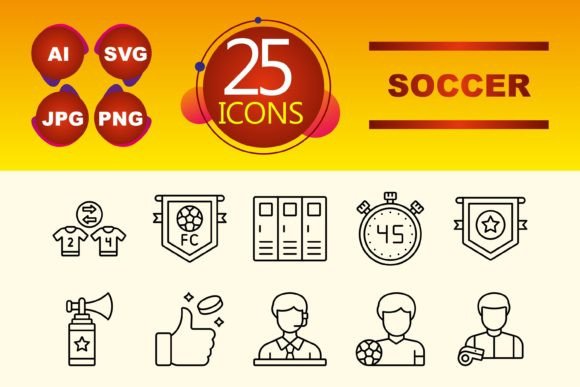
In the crowded digital landscape, clear visual communication is paramount. Whether you are designing a mobile application, developing a website template, or creating a presentation, the specific set of assets you choose defines the user experience. A high-quality Soccer icon set is not merely a collection of drawings; it is a functional toolkit that bridges the gap between complex ideas and instant user recognition. This specific collection of line icons is engineered for versatility, catering to developers, designers, and content creators who require precision and scalability.
The Aesthetic Power of Line Icon Styles
The decision to use line icons over filled, solid graphics often comes down to modern UI trends and readability. Line icons offer a lighter visual footprint, which is crucial for maintaining fast load times on websites and avoiding cluttered interfaces on mobile screens. This particular Soccer set utilizes a clean, stroke-based approach that ensures legibility even at small sizes. The minimalist nature of line icons allows them to blend seamlessly into diverse design languages, from flat design to semi-realistic interfaces. They provide a professional, polished look without overwhelming the primary content of your application or presentation.
Furthermore, line icons possess a unique adaptability regarding color. Because they rely on strokes rather than solid fills, they can easily be recolored to match specific brand guidelines or dark mode settings. For a Soccer-themed project, this means you can quickly shift the iconography from a vibrant grass-green to a sleek monochrome palette for a professional corporate presentation, all while maintaining the structural integrity of the icon.
Comprehensive Asset Formats for Every Workflow
A common bottleneck in the design process is file compatibility. This Soccer icon set addresses that issue by providing a robust selection of file types, ensuring smooth integration into virtually any workflow. The included formats are AI, JPG, PNG, and SVG.
- AI (Adobe Illustrator): This is the master vector file. For designers who need to modify the stroke weight, alter the shape of a Soccer ball, or customize the details of a player silhouette, the AI file is essential. It offers infinite scalability and full editability.
- SVG (Scalable Vector Graphics): This is the gold standard for web and app development. SVGs are lightweight, load instantly, and scale to any screen resolution without pixelation. Developers prefer SVGs for responsive websites because they look crisp on both standard monitors and high-density Retina displays.
- PNG (Portable Network Graphics): For situations where code integration isn't possible, such as social media posts, PowerPoint presentations, or drag-and-drop website builders, the PNG format is invaluable. These files typically come with transparent backgrounds, allowing the Soccer icons to be placed over any image or color without a white box surrounding them.
- JPG (Joint Photographic Experts Group): While less flexible than PNG for icons due to the lack of transparency, JPGs are universally supported and have small file sizes, making them useful for quick mockups or documentation where vector precision is less critical.
Practical Applications Across Industries
The utility of a Soccer icon set extends far beyond sports blogs. The versatility of these 10 distinct icons allows them to serve various sectors, each with different goals and audiences.
Mobile App Development
For developers building fitness trackers, betting platforms, or sports news aggregators, UI clarity is a direct contributor to retention rates. Using these Soccer icons for navigation bars, tab bars, or feature lists helps users intuitively understand the app's functions. For example, a Soccer ball icon instantly signals "Match Center," while a whistle icon might denote "Referee Stats." Because the set includes 10 variations, developers can create a comprehensive navigation system without needing to source graphics from multiple conflicting libraries.
Web Design and Templates
Web designers frequently struggle to find iconography that matches the specific tone of a template. This set is ideal for e-commerce sites selling equipment, fan community forums, or coaching academies. In a pricing table layout, for instance, a line icon representing a trophy or a jersey can visually distinguish between "Amateur" and "Pro" tiers. The line style ensures that these visual cues do not distract from the conversion-focused elements like "Buy Now" buttons.
Infographics and Data Visualization
When presenting data regarding League statistics, viewership numbers, or equipment sales, text alone can be dry. Integrating Soccer icons into infographics breaks up large blocks of text and aids in data retention. A bar chart showing "Goals per Season" becomes significantly more engaging when capped with a small icon of a net or a goalpost. The scalability of the SVG format ensures that these icons remain sharp even when printed on large physical posters or projected in auditoriums.
Corporate Presentations and Education
Educators teaching physical education or business professionals pitching a sponsorship deal to a Soccer club need to convey professionalism. Generic, low-resolution clipart can undermine credibility. Using a high-quality, cohesive set of line icons elevates the visual standard of a slide deck. It signals to the audience that the presenter has paid attention to detail. For example, using a specific icon to represent "Teamwork" or "Strategy" can visually reinforce the spoken narrative.
Enhancing User Experience and Branding
Consistency is the cornerstone of strong branding. If a business uses one style of icon on their website and a completely different style in their mobile app, it creates a disjointed brand identity. By utilizing the same 10 Soccer icons across all platforms—web, mobile, and print—businesses create a unified visual language. This subconsciously builds trust with the user.
From a usability standpoint, icons reduce cognitive load. A user scanning a webpage can identify a "Soccer Equipment" section much faster if it is marked with a recognizable icon than if they have to read a text header. This speed of navigation is critical for user satisfaction, particularly on mobile devices where screen real estate is limited and users expect immediate gratification.
Recommendations for Implementation
When integrating these Soccer assets into your project, consider the following practical tips to maximize their effectiveness:
- Respect the Padding: Even though the icons are clean, ensure there is sufficient whitespace around them. Cramping icons next to text makes the interface look cluttered and reduces the "clean" aesthetic that line icons are known for.
- Consistent Stroke Weight: If you are using the AI files to edit the icons, ensure that if you change the stroke weight on one Soccer icon, you apply that same change to all others in the set. Inconsistency in line thickness looks unprofessional.
- Color Contrast: While line icons are sleek, thin lines can sometimes disappear against busy backgrounds. Ensure there is high contrast between the icon color and the background. If using the icons over an image, consider adding a subtle drop shadow or a semi-transparent shape behind the icon to ensure legibility.
- Contextual Relevance: With 10 icons available, choose the one that best fits the specific context. Don't use a Soccer ball icon for a section about "History" if you have a trophy or a vintage flag icon available that conveys history more accurately.
Ultimately, this Soccer icon set is a strategic asset for anyone working in the digital space. By combining the elegance of line art with the utility of multiple file formats, it solves the common design problem of finding scalable, professional, and thematically accurate graphics. Whether you are building a complex sports application or a simple presentation, these icons provide the visual clarity and professional polish required to communicate effectively with your audience.