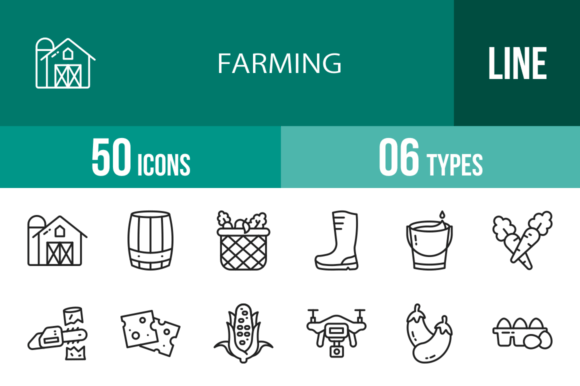
50 Farming Line Icons: Practical Guidance for Designers, Marketers, and Developers
Understanding the Value of Specialized Icon Sets
When you're building a website, mobile app, or presentation related to agriculture, finding the right visual assets can make or break your project's clarity. A collection of 50 farming line icons isn't just a random assortment of clip art—it's a carefully curated toolkit designed to communicate complex agricultural concepts through simple, recognizable symbols. From barns and tractors to seeds and sprouts, these icons serve as a visual language that bridges the gap between technical farming terminology and everyday understanding.
What makes a set like this particularly valuable is its specificity. Generic icon libraries often fall short when you need to represent niche concepts like irrigation systems, silos, or weather vanes. A dedicated farming icon set acknowledges that agriculture has its own visual vocabulary, and professionals in this space deserve tools that reflect that reality. Whether you're designing an agricultural education platform, creating marketing materials for a farm-to-table business, or developing a mobile app for crop management, having access to purpose-built icons saves time and improves communication.
Common Pitfalls When Selecting Farming Icons
One of the most frequent mistakes people make is choosing icons based solely on aesthetics without considering practical application. A beautiful icon rendered in a complex style might look stunning on your desktop screen, but it could become an illegible blur when scaled down for a mobile interface. This is why the unigrid system mentioned in professional icon sets matters so much. Icons designed on a consistent grid maintain their proportions and clarity across different sizes, which is essential for responsive design.
Another oversight involves file format selection. Many creators download icons in only one format, typically PNG, and then scramble when they need a vector version for print or a scalable version for web development. A comprehensive farming icon collection should include multiple formats—AI, CDR, EPS, JPG, PNG, and SVG—to cover the full spectrum of use cases. SVG files, for instance, are crucial for web applications because they scale perfectly without losing quality, while EPS files remain the standard for professional print workflows.
Why Format Diversity Actually Matters
Let's say you're a small business owner creating a brochure for your organic farm. You download a set of farming icons in PNG format, which works perfectly for your digital draft. However, when you send the file to your print shop, they request vector formats to ensure crisp output at larger sizes. Without AI or EPS versions, you're stuck either re-purchasing assets or settling for pixelated results. This scenario plays out more often than you'd think, and it's entirely avoidable with proper planning.
Similarly, developers building farming-related mobile applications need SVG files for their scalability and small file sizes. PNG files, while versatile, don't offer the same performance benefits on mobile platforms. Having access to all six formats—AI, CDR, EPS, JPG, PNG, and SVG—means you're prepared for virtually any project requirement without additional purchases or conversions.
Evaluating Icon Design Quality
Not all icon sets are created equal, and farming icons present unique design challenges. Consider the difference between a generic "plant" icon and a specifically designed "sprout" or "seeding" icon. The latter communicates a precise stage in the agricultural process, which matters when you're building educational content or specialized software. When evaluating a farming icon collection, look beyond the total count and examine whether each icon genuinely represents its intended concept with clarity and distinction.
Line icons, in particular, require careful attention to stroke weight and detail balance. Too thin, and they disappear on lower-resolution screens. Too thick, and they lose their elegance and become difficult to differentiate at smaller sizes. A well-designed set accounts for these variables, ensuring that icons like the chainsaw, pruners, and sickle remain distinguishable even when displayed side by side at reduced dimensions.
Practical Applications Across Industries
The versatility of a farming icon set extends far beyond obvious agricultural applications. Educators use these visual aids to teach students about food production and sustainability. Marketers leverage them to create compelling infographics about supply chains and farm-to-consumer journeys. App developers integrate them into user interfaces for agricultural technology platforms, while bloggers enhance their content with relevant visual cues that improve reader engagement and comprehension.
Consider a food blogger writing about seasonal produce. Instead of relying on generic stock photography, they could use the tomato, corn, carrot, and pumpkin icons to create custom visual elements that align with their brand identity. This approach not only saves money on licensing fees but also creates a cohesive visual experience that stock images rarely achieve.
Making Smart Decisions Before Downloading
Before committing to any icon set, take time to assess your actual needs. How many projects will you use these icons for? Will you need to modify colors or adjust line weights? Do you work across multiple platforms that require different file formats? Answering these questions upfront helps you avoid purchasing sets that lack essential features or, conversely, paying for complexity you'll never use.
Check whether the icons are truly vector-based and editable. Some sets marketed as "vector" actually contain rasterized elements embedded within vector files, which limits your ability to customize them. Authentic vector icons allow you to change colors, adjust stroke widths, and modify individual components using standard design software like Adobe Illustrator, CorelDRAW, or free alternatives like Inkscape.
Also consider the licensing terms carefully. Even if an icon set appears affordable, restrictive licensing might prevent you from using the icons in commercial projects, client work, or across multiple devices. Look for licenses that accommodate your intended use cases without requiring additional purchases for each application.
Integrating Icons Into Your Workflow
Once you've selected a quality farming icon set, integration becomes straightforward. For web projects, SVG files offer the best combination of quality and performance. You can style them with CSS, animate them with JavaScript, and they'll render crisply on any screen density. For print materials, EPS or AI files ensure your icons maintain professional quality at any size, from business cards to large-format banners.
Mobile app developers should consider how icons will function within their interface design system. Consistent sizing, alignment, and spacing matter as much as the icons themselves. A well-designed farming icon set built on a unigrid system simplifies this process because the icons are already harmonized for visual consistency.
Ultimately, investing in a thoughtfully designed collection of 50 farming line icons