Nanotechnology Line Icons: 50 Green & Black Designs for Projects
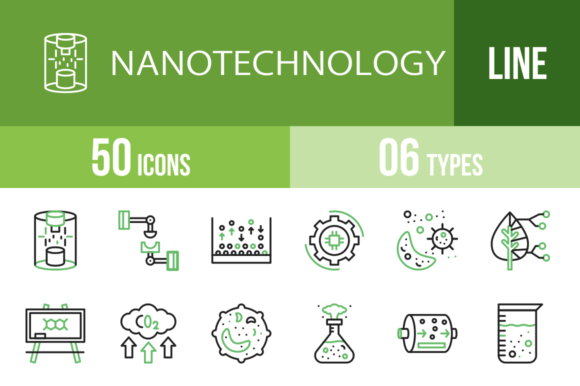
In the rapidly evolving world of nanotechnology, visual communication is often the bridge between complex science and public understanding. Whether you are developing a research paper, designing a mobile application for a biotech startup, or creating educational materials, the imagery you choose dictates how your audience perceives the content. The 50 Nanotechnology Line Green Black Icons set offers a sophisticated solution, blending the precision of scientific illustration with the versatility of modern vector design. This collection is not just a random assortment of graphics; it is a curated visual language designed to represent the microscopic world with clarity and style.
The Visual Language of Nanoscience
The choice of color in scientific and technical design carries significant weight. The combination of green and black utilized in this icon set is strategic. Black provides the structure, the "ink" of the schematic, grounding the icons in seriousness and technical accuracy. Green, often associated with biology, growth, and sustainability, injects life into the designs. It highlights key components—such as the DNA strands or the Nanobot mechanisms—making them pop against white or dark backgrounds. This dual-tone approach ensures that the 50 Nanotechnology Line Green Black Icons look equally professional on a corporate presentation slide as they do on a mobile app interface.
Designed using a unigrid system, these icons maintain consistent proportions and visual weight. This is crucial for maintaining a cohesive look across a user interface (UI) or a printed layout. When a user scans a dashboard featuring icons for Scanning Tunneling Microscopy, Atomic Layer Deposition, and Quantum Dots, the consistent grid system ensures that no single element feels out of place, creating a seamless user experience.
Practical Applications for Creators and Educators
The utility of this set extends far beyond simple decoration. For educators and publishers, these icons serve as powerful teaching aids. Nanotechnology concepts can be abstract; visualizing a Colloid or the process of Self Assembly requires clear imagery. By integrating these icons into textbooks or digital learning modules, educators can anchor abstract concepts to tangible symbols.
For mobile app developers and web designers, the icons are optimized for digital environments. The set includes formats like SVG and AI, which are infinitely scalable. This means a single icon of a Microscope or a Nanoparticle can be used as a tiny favicon in a browser tab and then scaled up to a hero image on a landing page without losing a single pixel of sharpness. The 100 vector icons (comprising 50 unique designs in two color variations) ensure that you have the flexibility to adapt to light and dark mode interfaces, a standard requirement in modern software development.
Specific Use Cases and Inspiration
Consider a startup developing a new Solar Panel technology utilizing nanomaterials. Their marketing materials need to convey innovation and precision. Using the Solar Panel and Molecular Electronics icons from this set allows the brand to visually articulate their technology without relying on generic stock photos. Similarly, a pharmaceutical company working on Molecular Medicine can use the DNA, Virus, and Cell icons to create a cohesive visual identity for their product packaging and presentations.
Here are a few ways to integrate these assets into your workflow:
- UI/UX Design: Use the icons for navigation menus in scientific software. For example, a "Research" tab could feature the Flask icon, while a "Settings" tab could utilize the Gear or Monitor icons.
- Infographics: When explaining the Arc Method or Chemical Vapor Deposition, use the corresponding icons to break up text and guide the reader's eye through the process step-by-step.
- Branding: A consulting firm specializing in Automated Engineering could use the Robotics and Nanomachine icons as part of their logo mark or business card design to instantly communicate their area of expertise.
Technical Versatility: Formats and Editing
A major pain point for designers is often file compatibility. This set addresses that by offering 6 different formats: AI, CDR, EPS, JPG, PNG, and SVG. This comprehensive range ensures that regardless of your preferred software—be it Adobe Illustrator, CorelDRAW, or simple drag-and-drop web builders—you can access and edit these assets immediately.
The "Line Green Black" style is also incredibly easy to edit. Because the icons are constructed using vector paths, you can easily adjust the stroke weight to make them bolder for print materials or finer for mobile screens. If your brand colors differ from the provided green and black, the vectors allow for instant recoloring. This adaptability means the 50 Nanotechnology Line Green Black Icons are a long-term investment for your design toolkit, adaptable to future projects and rebranding efforts.
Organizing Your Workflow
With 50 distinct concepts ranging from Bacterias to Nanofiltration, organization is key. When integrating these icons, it is helpful to categorize them by function. For instance:
- Process Icons: Arc Method, Chemical Reaction, Chemical Vapor Deposition.
- Tool Icons: Blackboard, Flask, Microscope, Scanning Tunneling Microscope, Test Tubes.
- Concept Icons: Compound, DNA, Genome, Layer, Monolayer.
- Application Icons: Ferrofluid, Nanobot, Nano Coating, Nanocrystal, Quantum Dot, Solar Panel.
By grouping the icons this way, you can maintain a logical flow in your designs. A presentation on Research might start with the Science Book and Scientist icons, move into the Process icons, and conclude with the Application icons. This structured approach helps in telling a coherent story, transforming a list of features into a compelling narrative about innovation.
Ultimately, the value of the 50 Nanotechnology Line Green Black Icons lies in their ability to make the invisible visible. They provide a bridge between the microscopic world of Nanoparticles and Neurons and the macroscopic world of user interfaces and printed pages. By utilizing these professional, scalable, and thoughtfully designed assets, creators can elevate their projects, ensuring that their visual communication is as advanced as the science it represents.